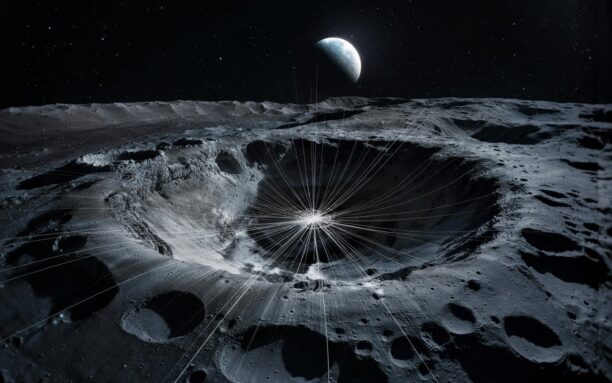
The Chang’e-6 mission returned about 2 kg of soil from the South Pole-Aitken (SPA) Basin, the Moon’s largest crater, spanning 2,500 km, providing new insights into the geology of the lunar far side. Research published in “Nature” explains the asymmetry between the Moon’s sides, where the far side’s crust is thicker and its terrain more rugged, revealing details about volcanism, magnetic fields, water distribution, and mantle composition.
Analysis of the samples showed that volcanic activity on the far side lasted longer than thought, with eruptions 4.2 and 2.8 billion years ago, indicating magmatic processes spanning 1.4 billion years. SPA basalts also revealed instability in the lunar dynamo: around 2.8 billion years ago, the magnetic field temporarily strengthened, contradicting models of its gradual decline. This refines our understanding of the Moon’s core evolution.
The soil’s geochemistry points to an “ultra-depleted” mantle with low volatile content, including water, compared to the near side. The giant impact that formed SPA 4.25 billion years ago likely “vaporized” volatile elements, amplifying the asymmetry. Additionally, comparison with Apollo mission data shows fewer basalts on the far side, underscoring its uniqueness.
These findings, complemented by infrared observations from the Chang’e-4 probe, confirm the impact of catastrophic collisions on the Moon’s structure. The Chang’e-6 results not only rewrite the Moon’s history but also deepen our understanding of planetary formation, promising new discoveries in the future.
#space #science #educational #technology