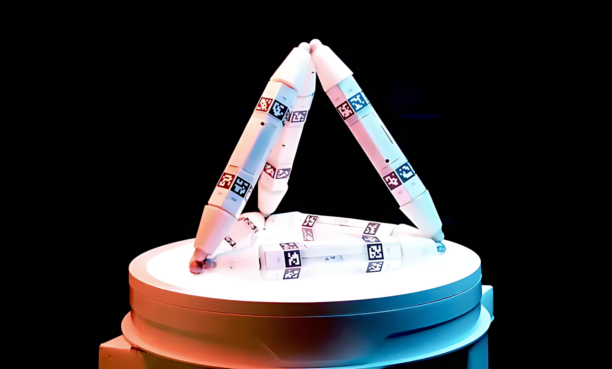
Engineers at Columbia University, backed by DARPA, have developed a “robotic metabolism” technology that enables robots to use parts from other machines for self-repair, growth, and evolution. This marks a significant step toward creating autonomous robotic ecosystems, where machines not only process information but can physically sustain themselves without human intervention. Researchers emphasize that true autonomy requires both intellectual and physical independence.
Modern robots boast advanced artificial intelligence but remain mechanically limited—unable to adapt or recover on their own. Inspired by biological organisms, scientists created a modular robot called “Truss Link”—a magnetic rod that can connect with other modules to form various shapes. Robots have learned to reconfigure from flat to three-dimensional structures and integrate new components to enhance their capabilities.
In experiments, one robot incorporated a “cane” module, boosting its speed on an inclined surface by 66.5%. This demonstrates machines’ ability to adapt and improve functionally. Despite sci-fi associations with self-replicating machines, scientists see such evolution as necessary—as robots grow in number, manual maintenance becomes impractical.
In the future, “robotic metabolism” technology could be applied in extreme conditions, such as disaster response or space exploration. It paves the way for fully autonomous machines capable of not just thinking but “living,” adapting to their environment like living organisms.
#space #science #educational #technology