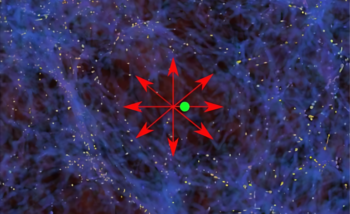
About a century ago, astronomers discovered that the universe isn’t static, as Einstein originally assumed, but is instead expanding — galaxies are moving away from one another. This led to a fundamental question: if space is expanding, where is its center? However, modern physics shows that this very question is flawed — in an expanding universe, there simply is no center. What’s expanding is not matter within space, but space-time itself — everywhere, all at once.
A good way to visualize this is to imagine the surface of an inflating balloon: every point on the surface moves away from every other point, but there is no central point on the surface itself. Our four-dimensional universe expands in a similar way — not “into” anything, but on its own, without edges or a center. The Big Bang didn’t happen at a single point in space, but simultaneously in every part of it, when all matter and energy were compressed into an extremely dense state.
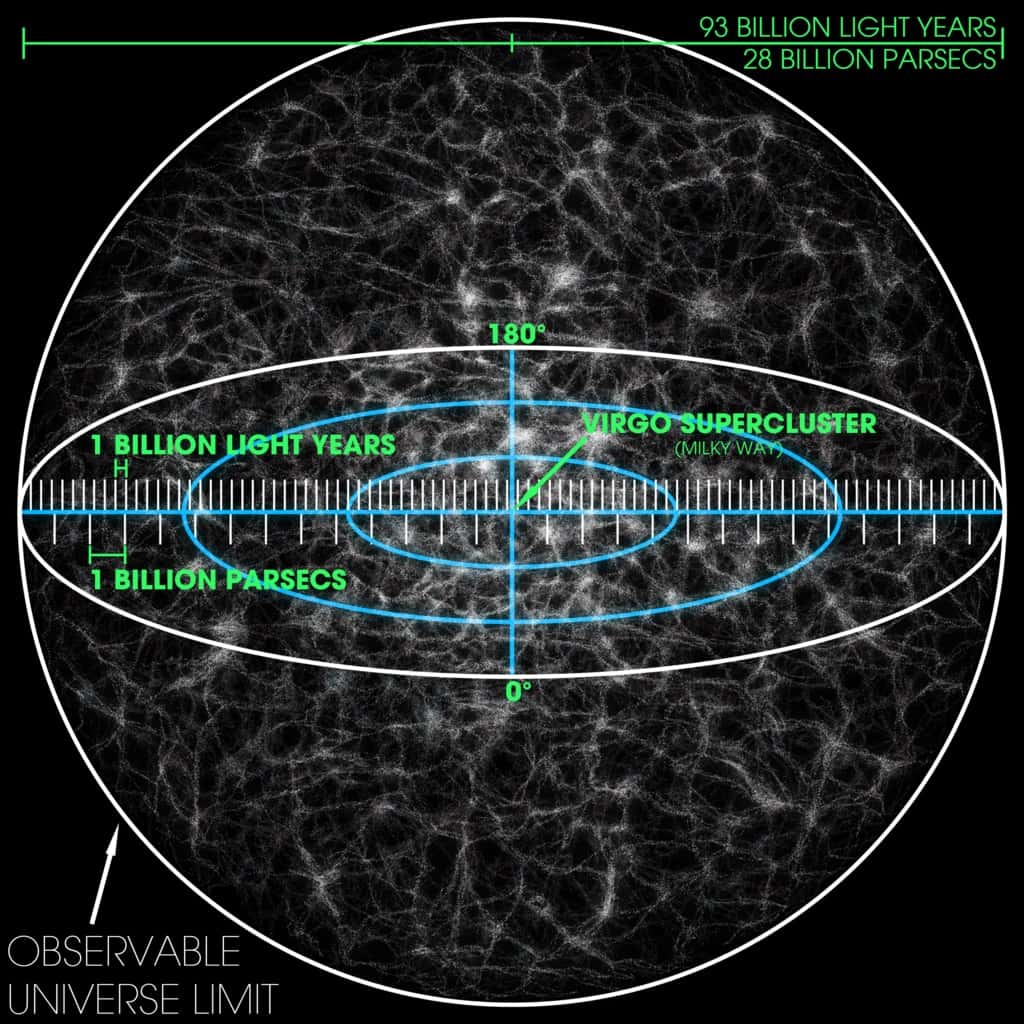
For a long time, scientists believed that gravity would eventually slow down this expansion. But in 1998, observations revealed that the expansion is actually accelerating. This is attributed to dark energy — a mysterious force that makes up about 70% of the total energy content of the universe. Its true nature remains one of the biggest puzzles in modern cosmology.
The idea of a boundless, ever-expanding universe with no center challenges our everyday intuition, but it is supported both by Einstein’s theory and by astronomical observations. We live inside a vast, dynamic structure — and while the universe may lack a center, our desire to understand it continues to be the starting point for discovery.
#space #science #educational #technology