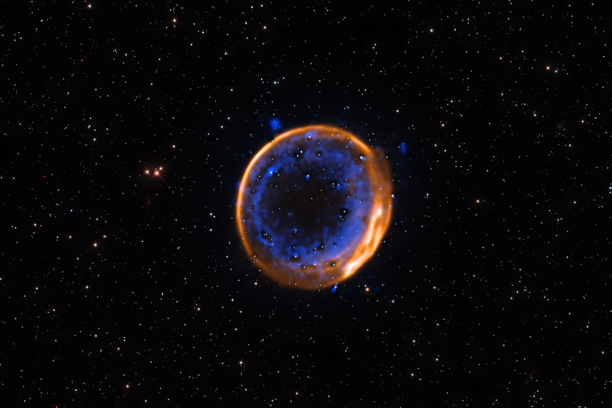
Astronomers using the European Southern Observatory’s Very Large Telescope (VLT) have obtained the first visual evidence of a double detonation in the supernova remnant SNR 0509-67.5, located in the Large Magellanic Cloud. The study, published in *Nature Astronomy*, reveals that some white dwarfs explode twice: first, the helium layer detonates, then the carbon-oxygen core. This discovery reshapes our understanding of Type Ia supernovae, used as “standard candles” to measure cosmic distances and study the universe’s evolution.
In the classic model, a Type Ia supernova occurs when a white dwarf accumulates mass up to the Chandrasekhar limit (1.4 solar masses), triggering a thermonuclear explosion. However, data from the VLT’s MUSE spectrograph revealed two layers of calcium in SNR 0509-67.5, ejected during two consecutive explosions. The initial helium detonation creates a shock wave, compressing the core and igniting a second, more powerful explosion, confirming the double detonation model.
This discovery explains the diversity of Type Ia supernova properties and their role in producing heavy elements like iron. It may also impact the accuracy of cosmological measurements, including estimates of the universe’s accelerated expansion. The double detonation mechanism suggests that not all supernovae reach the Chandrasekhar limit, necessitating refinements to existing models.
Further research will determine how common this scenario is. Observations of SNR 0509-67.5 highlight the complexity of stellar explosions and their significance for astrophysics, showing that some stars truly “die twice.”
#space #science #educational #technology