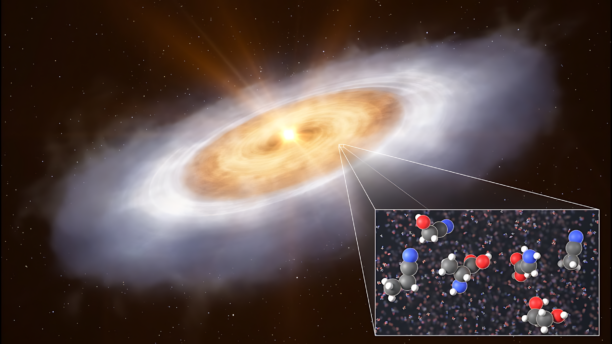
Astronomers from the Max Planck Institute for Astronomy, using the ALMA observatory, have detected complex organic molecules—such as ethylene glycol and glycolonitrile—in the protoplanetary disk surrounding the young star V883 Orionis. These compounds are known precursors to amino acids and DNA components, indicating that prebiotic chemistry may begin even before planets are fully formed. A burst of stellar activity heated the inner regions of the disk, causing icy grains to vaporize and release the trapped molecules, making them observable.
This discovery confirms that organic compounds formed in molecular clouds can survive the turbulent process of star formation and be carried into young planetary systems. While similar molecules had previously been found in comets, this is the first clear detection of such complexity within a protoplanetary disk—expanding our understanding of the chemical heritage stars pass on to their planets. The research also reveals that organic complexity increases as matter transitions from clouds to disks, challenging earlier beliefs that these molecules are destroyed during star birth.
Icy grains and ultraviolet radiation play a key role in forming complex organics. Simple molecules like ethanolamine can transform under UV light into more intricate ones—such as ethylene glycol, glycine, and others. These compounds may later become part of comets and asteroids, eventually reaching planets—possibly in the same way they once seeded Earth.
While the discovery marks a major step forward in understanding the origins of life, ALMA’s spectra still show unidentified lines, hinting at even more complex molecules yet to be confirmed. Scientists plan to continue observations at higher resolutions. All of this strengthens the idea that life’s emergence isn’t a rare cosmic fluke, but a natural outcome of widespread chemical evolution throughout the universe.
#space #science #educational #technology