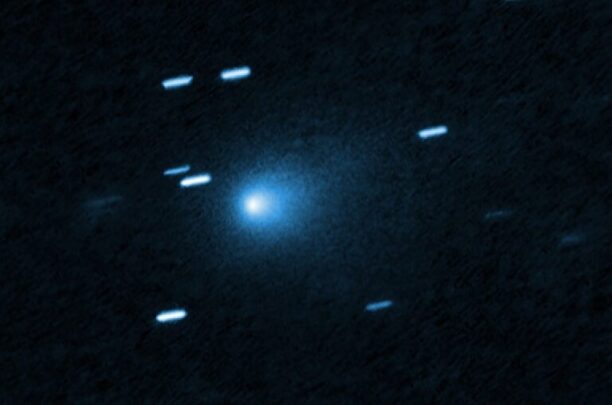
Astronomers using the Hubble Space Telescope have obtained the sharpest images yet of the interstellar comet 3I/ATLAS, discovered on July 1, 2025, by the ATLAS system in Chile. This is the third known object to enter the Solar System from interstellar space after billions of years traveling through the Milky Way. Initially, the nucleus size was estimated at up to 30 km, but a cloud of gas and dust obscured precise measurements. Hubble narrowed the range: the diameter is no more than 5.6 km, with a minimum of 320 m, and the likely value closer to the upper limit.
The images show the coma—an atmosphere of evaporating volatiles—and a tail pointing away from the Sun. Background stars appear streaked due to the telescope tracking the moving comet. The comet is approaching at a speed of 210,000 km/h (130,000 mph), making it the fastest interstellar visitor. Additional NASA data confirm its designation as C/2025 N1 (ATLAS), with an initial distance of 670 million km from the Sun.
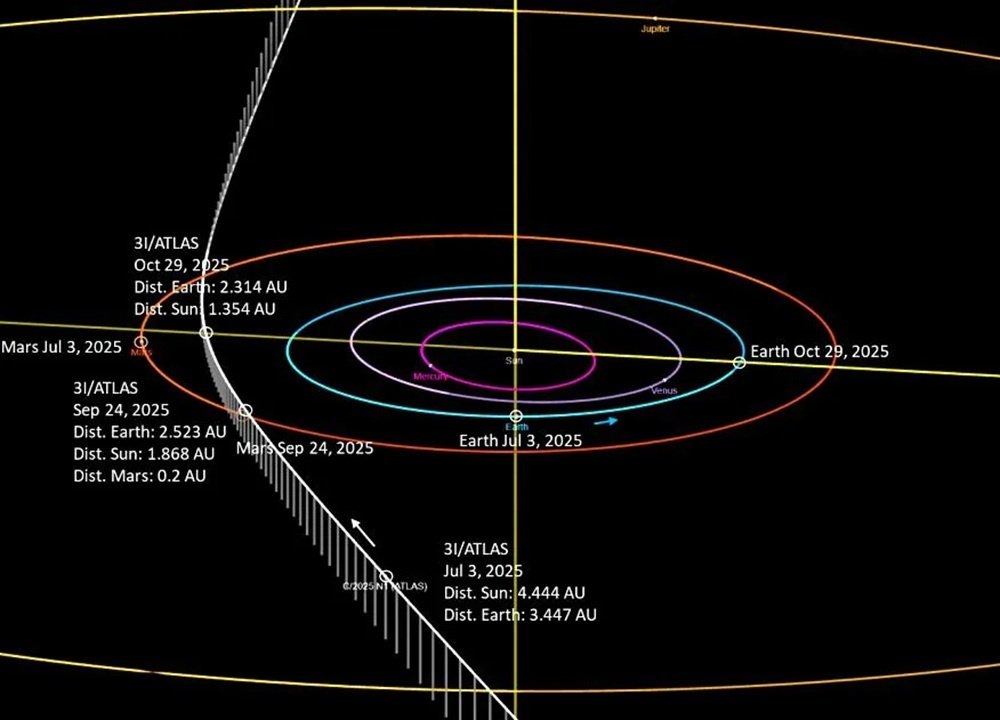
Closest approach to the Sun is expected on October 30, 2025, at 1.4 AU, inside Mars’s orbit, but the comet will be invisible from Earth from late September to December. Martian probes are proposed for observing its perihelion. ESA plans the Comet Interceptor mission by 2029—a probe on standby to intercept intriguing objects. Studies suggest 3I/ATLAS may be among the oldest comets, 3 billion years older than the Solar System, heightening scientific interest.
#space #science #educational #technology