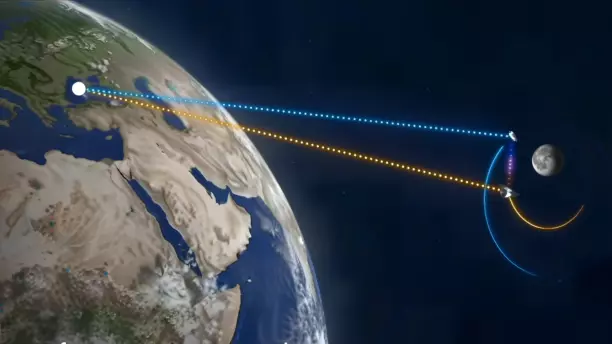
Chinese scientists from the Deep Space Exploration Laboratory (DSEL) have conducted a groundbreaking experiment: they directed a high-precision laser beam from Earth to the Tiandu-1 navigation satellite, which orbits the Moon at a distance of 130,000 kilometers. A major challenge was the sunlight reflected from the Moon’s surface, which typically interferes with laser pulses and makes daytime measurements highly inaccurate.
The satellite laser ranging method used in the experiment allows for determining the position of space objects with centimeter-level accuracy. It is based on launching nanosecond laser pulses that bounce off special equipment in orbit and return to Earth. Until now, such measurements over long distances were only possible at night due to solar interference.
However, in this new experiment, Chinese scientists successfully overcame this limitation and conducted laser ranging in broad daylight. The difficulty of the task has been compared to “hitting a hair from 10 kilometers away.” This achievement paves the way for continuous, round-the-clock data collection from lunar satellites.
In the future, this technology could provide stable and highly accurate communication with lunar rovers and astronauts, regardless of the time of day, significantly enhancing the effectiveness of upcoming lunar missions.
#space #science #educational #technology