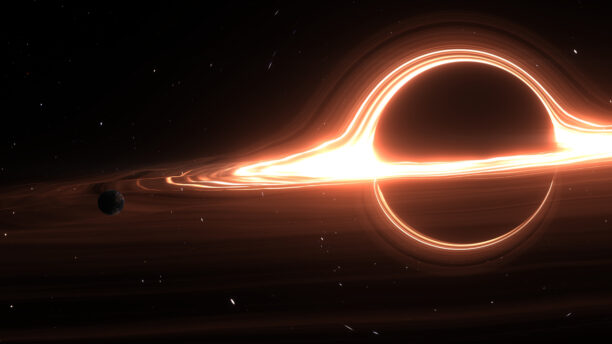
Scientists from Johns Hopkins University have proposed using supermassive black holes as natural analogues of supercolliders to search for dark matter and other fundamental particles. According to the authors of a study published in Physical Review Letters, these cosmic giants could offer a powerful and cost-effective alternative to building particle accelerators that require tens of billions of dollars and decades to complete.
Co-author of the study, astrophysicist Joseph Silk, notes that rapidly spinning black holes are capable of producing powerful jets of plasma — streams in which conditions are created similar to those achieved in man-made particle accelerators. The particles generated in these extreme processes possess energies that cannot be replicated in Earth-based laboratories.
The researchers suggest that such ultra-energetic particles could carry information about previously unknown aspects of the universe, including the nature of dark matter. To detect them, scientists propose using existing neutrino observatories like IceCube in Antarctica and KM3NeT in the Mediterranean Sea.
This approach opens up the possibility of studying fundamental physics through astronomical phenomena, providing a compelling example of how nature itself can act as a powerful scientific instrument — rivaling even the most advanced technology created by humans.
#space #science #educational #technology