
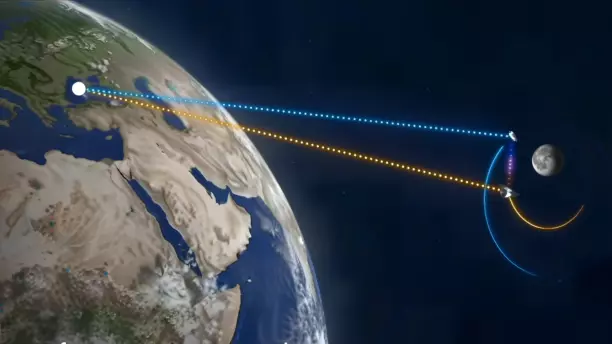
Chinese scientists from the Deep Space Exploration Laboratory (DSEL) have conducted a groundbreaking experiment: they directed a high-precision laser beam from Earth to the Tiandu-1 navigation satellite, which orbits the Moon at a distance of 130,000 kilometers. A major challenge was the sunlight reflected from the Moon’s surface, which typically interferes with laser pulses and […

Researchers from the UK, Germany, and Israel have proposed a bold hypothesis suggesting that gravitational waves played a key role in shaping the conditions necessary for life—and even human consciousness—on Earth. According to their theory, fluctuations in gravitational fields triggered by collisions between black holes and neutron stars may set off
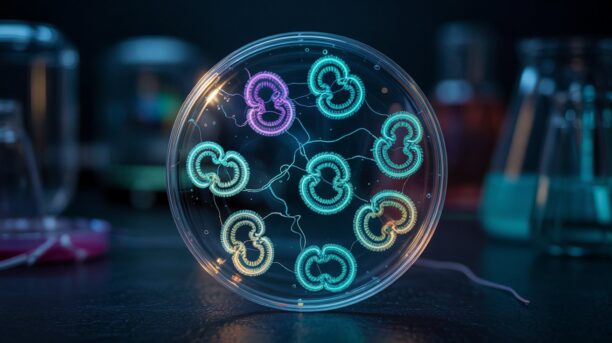
Researchers at Harvard University have made a groundbreaking discovery that challenges our understanding of life itself. They’ve shown that life-like processes—particularly self-replication—can occur without the involvement of biological molecules. In their experiments, the team created a synthetic system using amphiphilic block copolymers, built from simple chemical components.

NASA scientists have detected a mysterious object that absorbs all light and emits no heat—an anomaly first spotted on April 18, 2025, using the James Webb Space Telescope. At first, researchers thought it was a data error, as there was a complete absence of infrared response in a region where a star’s signal was expected. […]
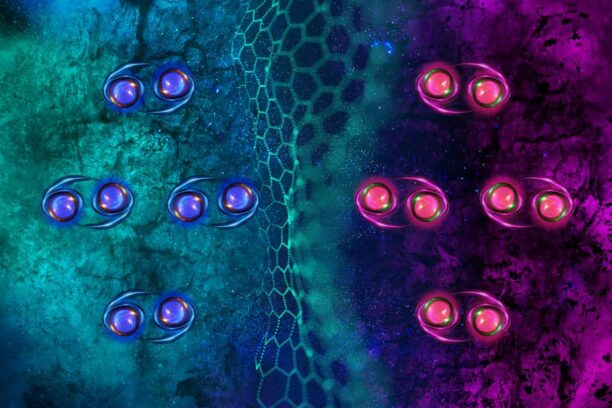
Physicists at MIT have discovered a new type of material—a chiral superconductor—that simultaneously exhibits superconductivity and intrinsic magnetism. This breakthrough was made in rhombohedral graphene, a special multilayer structure of graphite, when cooled to around 300 millikelvins. Remarkably, the material maintains superconductivity even in

Scientists from Nagoya University, Tohoku University, and other institutions have uncovered the origin of a rare mineral texture known as “striped olivine,” found in the chondrules of meteorites. These tiny spherical particles are considered time capsules, preserving the conditions of the early solar system. The study revealed that the characteristic