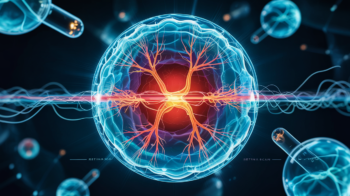
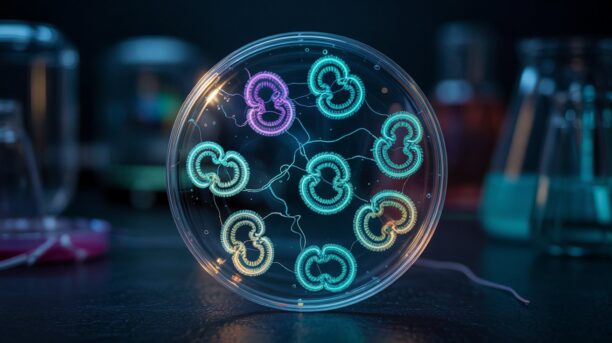
Researchers at Harvard University have made a groundbreaking discovery that challenges our understanding of life itself. They’ve shown that life-like processes—particularly self-replication—can occur without the involvement of biological molecules. In their experiments, the team created a synthetic system using amphiphilic block copolymers, built from simple chemical components. These molecules spontaneously formed cell-like vesicles, which, when exposed to light, not only remained stable but also produced “offspring” that inherited their characteristics.
The most remarkable aspect of this system is that it operates entirely without DNA, RNA, or proteins. Light triggered a process called photopolymerization, during which the synthetic “cells” released polymer spores that gave rise to new vesicles. This discovery reshapes our understanding of how life may have originated on Earth—suggesting that the earliest forms of life could have been far simpler and did not rely on complex biomolecules.
The breakthrough also has major implications for the field of synthetic biology. It opens the door to engineering artificial systems capable of self-assembly and even evolution. Additionally, it redefines how we search for extraterrestrial life. If self-replication can occur purely through chemistry, then alien life could look nothing like anything we know on Earth.
In essence, the work by the Harvard team challenges long-standing assumptions about what it means to be alive and paves the way for the creation of fully synthetic “living” systems. It invites us to reconsider a fundamental question: What truly makes something alive?
#space #science #educational #technology