
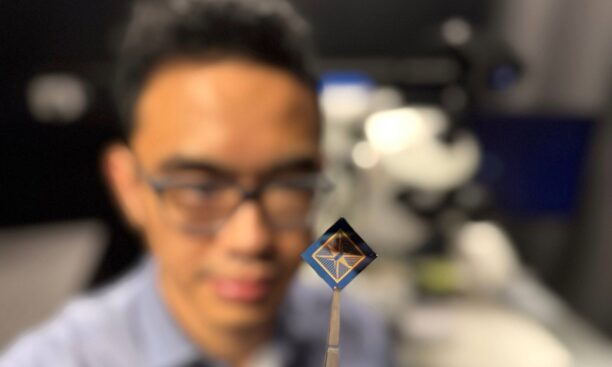
Engineers at Sweden’s KTH Royal Institute of Technology have developed a neuromorphic device based on molybdenum disulfide (MoS₂) that processes visual information similarly to the human brain—without the need for an external computer. The device can detect motion, retain visual memory, and consumes minimal energy, paving the way for applications in autonomous vehicles, robotics, and wearable electronics.
At the core of the technology are ultrathin MoS₂ layers with atomic defects, created through chemical vapor deposition. These layers are light-sensitive and convert optical input into electrical signals, mimicking the function of neurons. Researchers leveraged these properties to build a spiking neural network (SNN), achieving 75% accuracy in recognizing static images and 80% accuracy in dynamic tasks after several training cycles.
The system can detect motion and outline shapes without needing frame-by-frame image processing, significantly reducing memory load and power consumption. Detected changes are stored directly in the device, emulating the way the brain stores information. A major advancement is its operation under visible light, unlike previous models that were limited to ultraviolet wavelengths.
In the future, this technology could improve the responsiveness and accuracy of autonomous systems operating in unpredictable environments—especially in scenarios where quick adaptation is critical, such as human-robot interaction. A preliminary patent has been filed, and work is underway to scale the prototype to a full-size sensor, as well as to explore new materials for infrared vision.
#space #science #educational #technology


