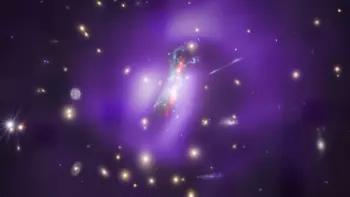

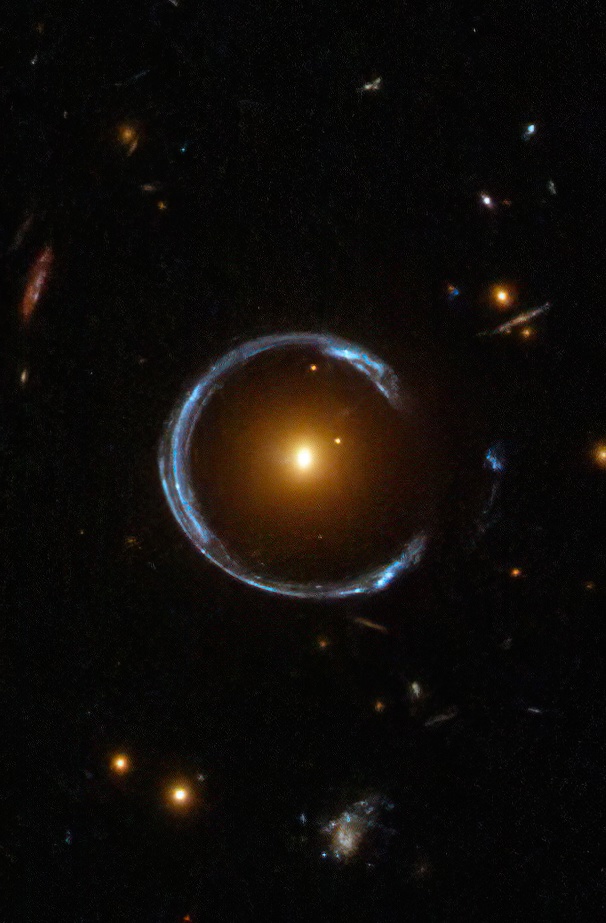
Astronomers have conducted a new analysis of the gravitational lens known as the “Cosmic Horseshoe” (SDSS J1148+1930) and discovered one of the most massive black holes in the universe at the center of the lensing galaxy. According to calculations, its mass is about 36 billion solar masses—far exceeding that of the supermassive black hole Sagittarius A* at the center of the Milky Way. The study is based on data obtained from the Hubble Space Telescope and the MUSE spectrograph on the VLT telescope.
A key indicator of the presence of this giant black hole is the discovery of a “radial arc”—distorted light from a distant galaxy passing through the gravitational field of the lensing object. By analyzing the shape of this arc and the velocities of stars in the lensing galaxy, astrophysicists modeled the mass distribution and concluded that a supermassive black hole is indeed present at the center.
Scientists suggest that such an enormous mass could have formed through the mergers of massive galaxies and their black holes or through rapid mass accumulation in the early universe. However, since the discovery was made using an indirect method, further studies of similar gravitational lenses are needed to confirm these hypotheses. Future observations will help clarify how black holes grow to such immense sizes and how they influence galaxy evolution.
#space #science #educational #technology