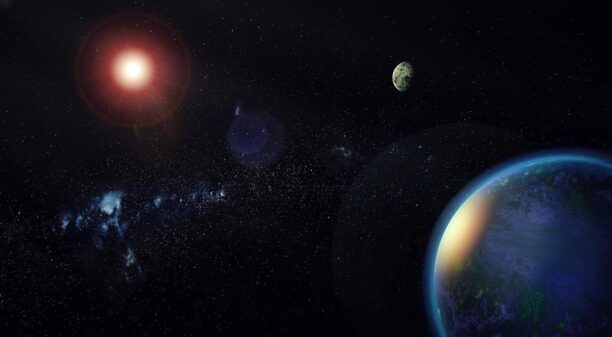
Astronomers have discovered two exoplanets—a super-Earth and a sub-Neptune—orbiting the star TOI-1453, located 250 light-years from Earth in the constellation Draco. These types of planets are common in the galaxy but absent from our Solar System. The discovery provides valuable insights into their formation and evolution, as well as the dynamics of planetary systems. The finding was made possible thanks to data from the TESS space telescope and the HARPS-N spectrograph.
TOI-1453 b is a super-Earth, slightly larger than our planet, likely with a rocky composition and a short orbital period of just 4.3 days. TOI-1453 c is a sub-Neptune with an extremely low density, suggesting it may have a thick hydrogen atmosphere or a high water content. With a mass of only 2.9 Earth masses, it is one of the least dense sub-Neptunes known to science. The planets are in a 3:2 orbital resonance, providing crucial data on planetary migration and orbital stabilization.
Using the transit and radial velocity methods, scientists accurately determined the planets’ sizes, orbits, and masses. The low density of TOI-1453 c makes it an ideal candidate for future studies, including atmospheric analysis with the James Webb Space Telescope. Further investigation of this system will deepen our understanding of sub-Neptune formation and their role in planetary evolution.
#space #science #educational #technology