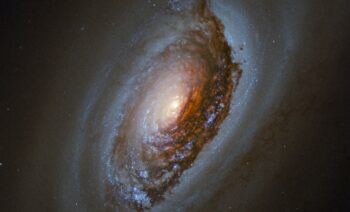

Astrophysicists have discovered that the giant bidirectional plasma jets observed in space follow a universal physical principle. These powerful ejections, known as astrophysical jets, are most commonly associated with black hole activity. When a supermassive black hole actively consumes matter, some of it is expelled into space as narrow, relativistic streams stretching for thousands of light-years. However, similar phenomena have also been observed around other objects, such as young stars and neutron stars, raising questions about the unified nature of these processes.

Previously, it was believed that jet formation was linked to the magnetic fields of their parent objects. One hypothesis suggested that magnetic field lines at the poles of a black hole or star could form structures resembling “towers” that guide plasma flows. However, this theory fails to explain all observed features. The new study proposes an alternative mechanism, suggesting that jets behave similarly to hot gas flow in a jet engine, passing through a Laval nozzle.
According to this explanation, environmental pressure acts as the “walls” of the nozzle: near a massive object, matter is compressed and accelerated to the speed of sound. As the pressure decreases with distance, the flow further accelerates to supersonic speeds. This process explains why jets appear around such a wide range of cosmic objects, regardless of their nature.

This discovery not only sheds light on the mechanisms behind astrophysical jets but also offers new insights into accretion and matter ejection processes under extreme conditions in the universe.
#space #science #educational #technology