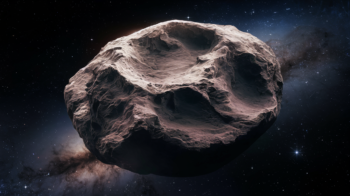
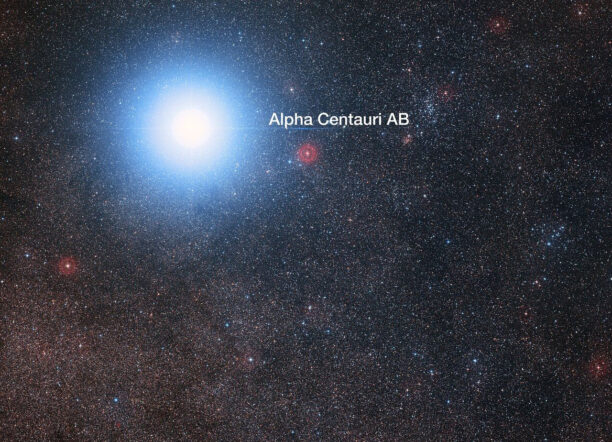
Interstellar objects like ‘Oumuamua and the Borisov comet, which passed through the Solar System in 2017 and 2018, demonstrated that celestial bodies can travel across the Milky Way and cross our system. In a new study, scientists from the University of Western Ontario calculated how much material from Alpha Centauri could have already entered the Solar System. The Alpha Centauri planetary system is moving toward us at about 79,000 km/h, and in 28,000 years, it will reach its closest point, about 20,000 astronomical units from the Sun. Material from this system may already be present in our Solar System.
The research showed that interstellar matter from Alpha Centauri, including particles from planetesimals, asteroids, and comets, has likely already entered the Oort Cloud. Given the system’s age of about 5 billion years, the likelihood of gravitational scattering of these particles is high. Based on observations, such as dust detected by the Cassini probe, scientists predicted that around a million particles, ranging from 10 microns to several dozen meters in diameter, originating from Alpha Centauri, are already present in the Solar System.
Most of these particles are located in distant regions, making them difficult to identify with telescopes. Some may have entered Earth’s atmosphere and become meteors, and their numbers will continue to increase over the next 28,000 years. This discovery confirms that the Solar System is not isolated from the rest of the galaxy, and material exchange between systems is ongoing. For further study of interstellar objects, scientists have proposed missions with research probes to capture such objects in the future.
#space #science #educational #technology