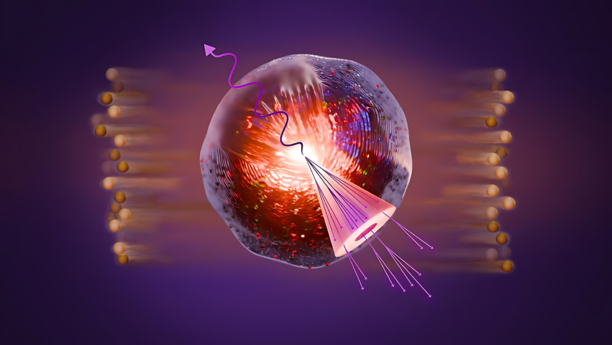
Physicists at Brookhaven National Laboratory have made significant progress in studying quark-gluon plasma (QGP)—an extremely hot and dense state of matter that existed during the first microseconds after the Big Bang. Using the Relativistic Heavy Ion Collider (RHIC), they investigated how high-energy particle jets interact with this exotic medium. The STAR collaboration’s unique approach involved using photons—which don’t interact with QGP—as a reference point to accurately measure how jets lose energy. This enabled a deeper understanding of how the plasma’s properties influence jet structure and how energy is redistributed within the QGP.
Their studies showed that jets lose energy while traversing the plasma, but the energy doesn’t disappear—instead, it is “smeared” sideways, exciting the medium much like waves radiating out from a stone dropped in water. This effect helps researchers study the dynamics of plasma that exists for only femtoseconds. The analysis revealed that QGP behaves like a nearly perfect liquid, raising new questions about its viscosity and how interactions vary with the distance traveled by the jets.
While this discovery marks a breakthrough, it opens numerous new avenues for research, including refining the internal structure of QGP and exploring similar forms of matter in astrophysical objects like neutron star cores. The study shows that jets and photons can be used not just for observation, but as active probes of extreme matter.
According to physicist Peter Jacobs, the STAR team’s methodology changes the very approach to QGP research: jets are no longer just objects of study, but tools—”probes”—that allow scientists to peer into the fundamental nature of quark-gluon plasma. This approach opens new horizons for understanding matter and the foundational processes that shaped the Universe immediately after its birth.
#space #science #educational #technology