
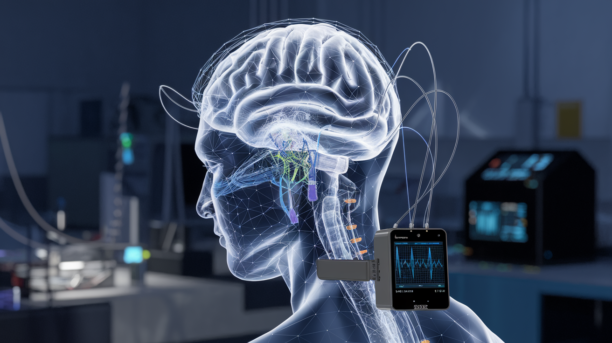
Chinese scientists have developed the world’s first bidirectional adaptive brain-computer interface (BCI), which is 100 times more efficient and 1,000 times more energy-efficient than traditional technologies. This neural interface uses dual-loop feedback and machine learning, allowing the brain and device to learn from each other. The breakthrough opens the door for portable and wearable BCIs for everyday and medical applications.
Traditional BCIs, which emerged in the 1970s, have been used in fields ranging from rehabilitation to gaming and drone control. However, the lack of feedback limits their effectiveness since the brain cannot adapt and refine control. The new study demonstrates that changes in brain signals are influenced not only by fatigue or emotions but also by interaction with the interface. This led to the development of a system featuring a memristor-based chip that mimics neural networks.

By leveraging machine learning, the neural interface adapts to changes in brain activity and provides real-time feedback with high precision. Unlike most BCIs, which are restricted to two control directions, the new system supports four degrees of freedom, including forward/backward movement and rotation. During a six-hour experiment with 10 volunteers, the adaptive BCI demonstrated 20% higher accuracy than traditional interfaces.
The U.S., Europe, and China are actively advancing BCI technologies. While Elon Musk’s Neuralink focuses on implantable solutions, Chinese researchers are making significant progress in developing non-invasive and adaptive interfaces that could greatly enhance human-computer interaction.
#space #science #educational #technology