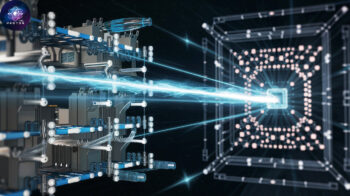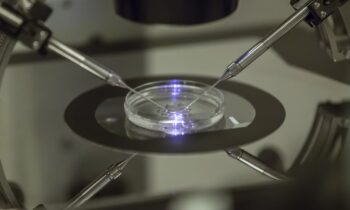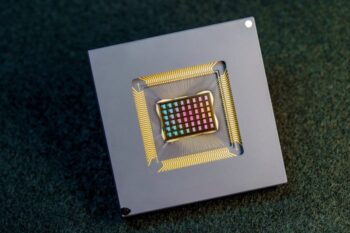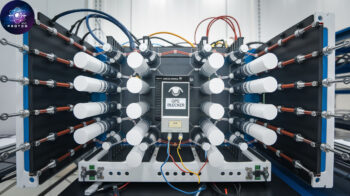

For the first time, scientists have used a quantum computer to model a catastrophic scenario—false vacuum decay, a theoretical event that could annihilate the universe in an instant. A team from the University of Texas at Austin employed a 5,564-qubit D-Wave quantum annealer to investigate how this process might unfold. Their findings, published in Nature Physics, provide new insights into vacuum stability and showcase the power of quantum computing in fundamental physics.
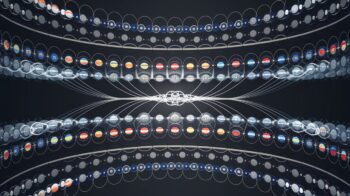
According to quantum field theory, the vacuum can exist in a metastable state, and a spontaneous transition to a true vacuum would trigger a bubble that expands at the speed of light, erasing everything in its path. While this scenario may sound like science fiction, physicists take its possibility seriously. Previous simulations of this process were challenging, but quantum computers—capable of handling vast numbers of simultaneous states—allowed researchers to model the formation and evolution of true vacuum bubbles.
The experiment revealed complex interactions between these bubbles: they merged, expanded, and formed unique patterns, confirming theoretical predictions. Although the likelihood of imminent vacuum decay is low—calculations suggest that the Higgs field remains stable for trillions of years—this research is crucial for cosmology, shedding light on phase transitions in the early universe and the fundamental nature of space.
Moreover, the study highlights the growing power of quantum computers, which, while not yet replacing classical machines, are already solving problems beyond the reach of traditional computing. Researchers now plan to extend their simulations to two dimensions, offering deeper insights into one of the most enigmatic processes in the universe.
#space #science #educational #technology