
Physicists from the University of Southampton have successfully created the first laboratory-based analog of superradiance—an effect predicted in the 1970s by Roger Penrose and Yakov Zel’dovich. According to theory, a rotating black hole can transfer part of its energy through a mechanism operating in the ergosphere—a region where spacetime is dragged by the black hole’s rotation. Zel’dovich proposed that a similar process could occur when electromagnetic waves interact with a rotating metallic cylinder in a closed resonant system.
In the experiment, researchers used a setup involving a rotating aluminum cylinder, magnetic coils, and a reflective cavity. When the cylinder spun faster than the magnetic field, the amplitude of the electromagnetic waves increased, confirming the predicted superradiant effect. If the cylinder rotated more slowly or in the opposite direction, the wave amplitude diminished—again in perfect agreement with theoretical expectations.
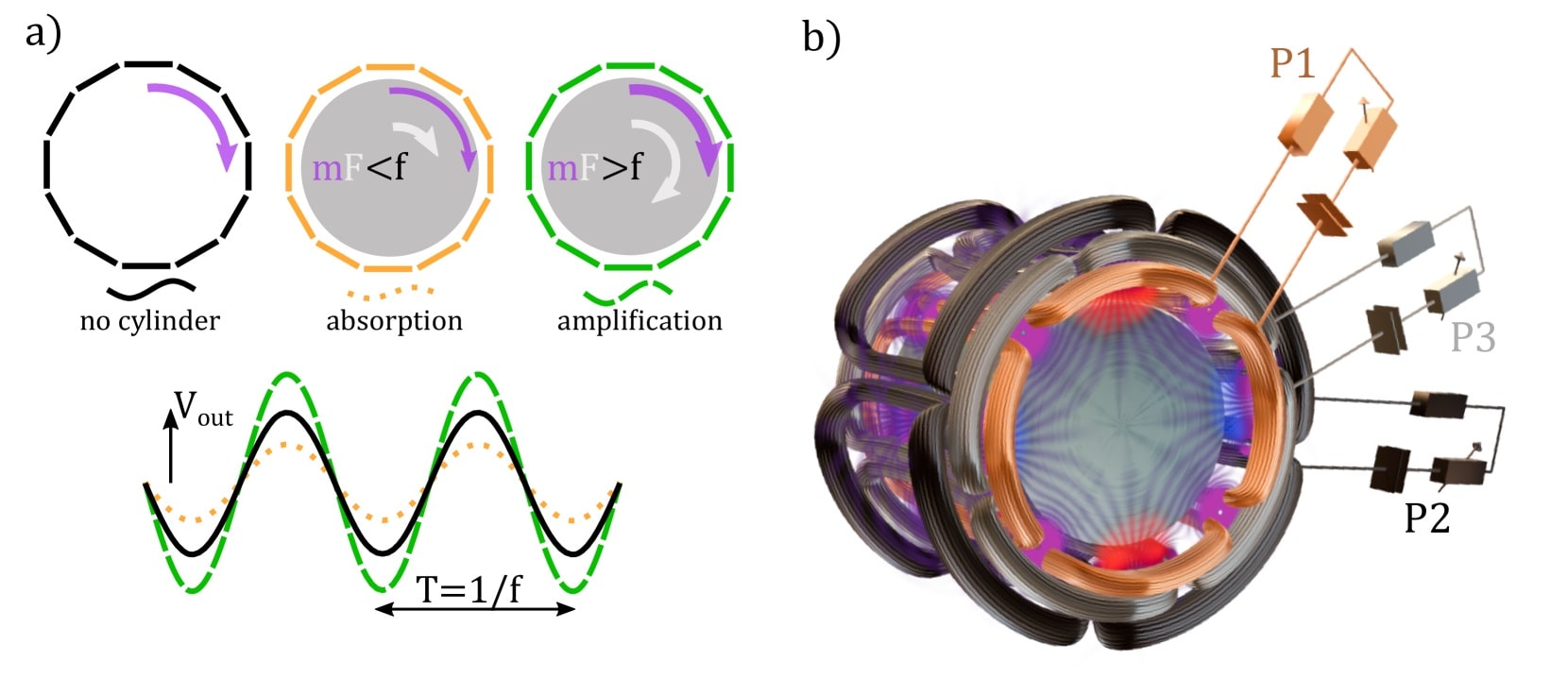
This laboratory analog of a black hole simulates the ergosphere, where electromagnetic fields can extract energy from a rotating surface. Multiple reflections within the cavity produced a buildup of energy, mirroring what’s predicted in the so-called “black hole bomb” scenario. This marks the first experimental confirmation of such a complex astrophysical phenomenon under controlled conditions.
Though simplified compared to real black holes, the experiment paves the way for further studies of extreme processes in the universe and could even inspire practical technologies for wave amplification and compact energy sources. The achievement represents a major step in fundamental physics and demonstrates the potential of simulating relativistic effects in the lab.
#space #science #educational #technology


