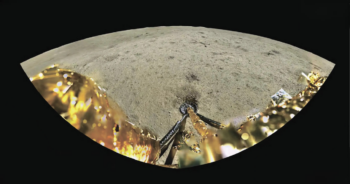

China’s Chang’e-6 mission has made a significant breakthrough in lunar research by studying the South Pole–Aitken Basin, the largest and one of the oldest impact craters in the Solar System. This crater, measuring 2,500 km in diameter and 10 km deep, is located on the Moon’s far side. Data from Chang’e-6 has determined its age to be 4.25 billion years—just 320 million years younger than the Solar System itself. This discovery provides crucial insights into the Moon’s early geological history and evolution.
Launched in May 2024, the mission successfully returned 1,935.3 grams of lunar samples to Earth, including 20 representative norite fragments—magmatic rocks from the lunar crust. Scientists used lead-lead dating to determine two major impact events: the basin’s formation 4.25 billion years ago and a later impact 3.87 billion years ago. These findings confirm the Aitken Basin’s critical role in shaping the Moon’s history.
One challenge was that the Apollo Crater, the mission’s landing site, contains rocks from multiple sources due to subsequent impacts and volcanic activity. However, researchers identified the oldest samples directly linked to the basin’s formation. The study, published in National Science Review, marks the first precise dating of this crater, refining the timeline of early Solar System events.
Chang’e-6 has strengthened China’s position in space science and made a major contribution to planetary research. Further analysis of the samples may reveal new insights into lunar crust formation, volcanic activity, and even the origins of water in the Moon’s permanently shadowed polar regions.
#space #science #educational #technology