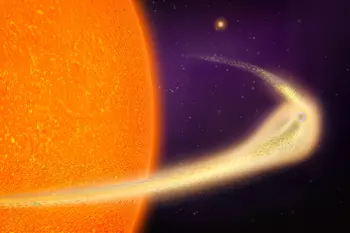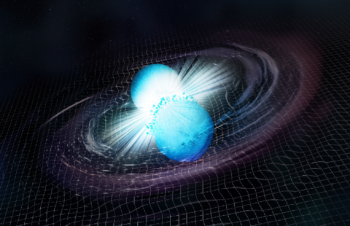
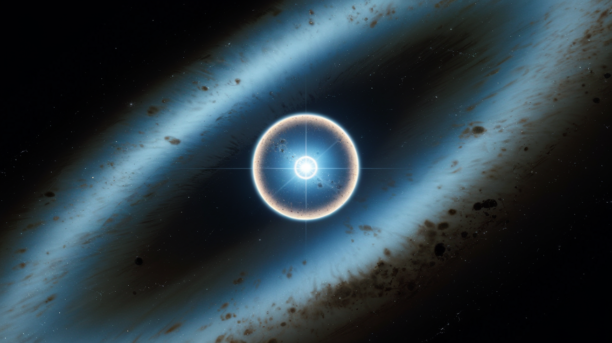
A new study led by Paolo Padoan from the University of Barcelona is reshaping our understanding of how planetary disks form around young stars. Published in Nature Astronomy, the research shows that a star’s environment plays a crucial role in determining the size and lifespan of its disk, largely through a process known as Bondi-Hoyle accretion — where the star pulls in additional material from its surrounding gas cloud. This updated view helps explain the observed sizes of protoplanetary disks and resolves inconsistencies in previous models.
Using advanced computer simulations and data from the ALMA radio telescope, scientists demonstrated that Bondi-Hoyle accretion not only increases the mass of the disk but also adds extra angular momentum. As a result, disks can remain massive and stable for much longer than previously thought. The modeling also provided deeper insights into the structure of interstellar gas, including its density, velocity, and magnetic fields over time.
Researchers note that growing supercomputer capabilities and the advent of new telescopes like James Webb and ALMA will enable even more precise simulations and observations of star formation processes. This, in turn, will expand our knowledge of how planetary systems emerge.
The study’s findings have important implications not only for understanding star and planet formation but also for identifying environments that could be favorable for the emergence of life elsewhere in the universe.
#space #science #educational #technology