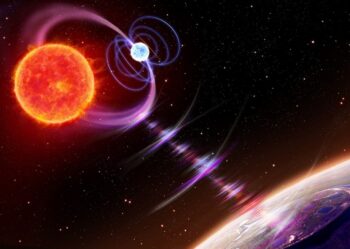
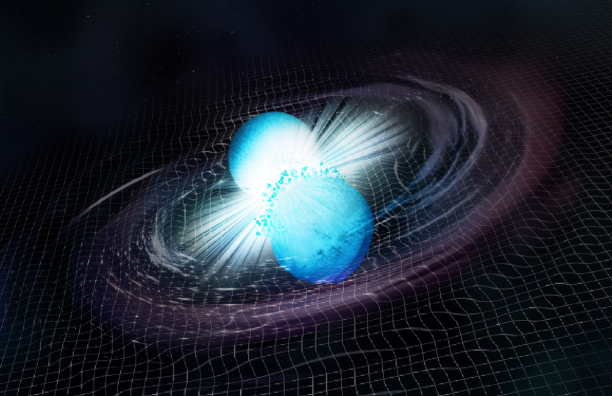
Neutron star mergers are among the most powerful events in the universe, involving collisions between the ultra-dense remnants of massive stars. These cosmic events generate gravitational waves, electromagnetic radiation, and heavy elements, while also offering a unique window into the behavior of matter at extreme densities. A key component in understanding these mergers is the equation of state (EoS), which describes the relationship between pressure, temperature, and density. However, magnetic fields—which can be billions of times stronger than Earth’s—play a critical but long-underestimated role in this process.
A team of researchers from the U.S. and Spain conducted numerical simulations of neutron star mergers to investigate the impact of magnetic fields on the gravitational wave spectrum. The study, published in Physical Review Letters, revealed that magnetic fields significantly shift the oscillation frequencies generated after the merger. This can complicate the interpretation of gravitational wave signals and obscure other physical phenomena, such as phase transitions in dense matter.
The simulations used general relativistic magnetohydrodynamics (GRMHD), which accounts for both strong gravitational forces and plasma behavior. Researchers tested various EoS models, magnetic field configurations, and stellar masses. The results emphasize that accurate interpretation of gravitational wave signals is not possible without factoring in magnetic effects—particularly in the era of next-generation detectors like the Cosmic Explorer and the Einstein Telescope.
The authors stress that the future of gravitational wave astronomy depends on a holistic approach that incorporates both dense matter physics and magnetic dynamics. This is especially relevant following events like GW170817—the first observed neutron star merger—which marked a milestone in the advancement of multi-messenger astronomy.
#space #science #educational #technology