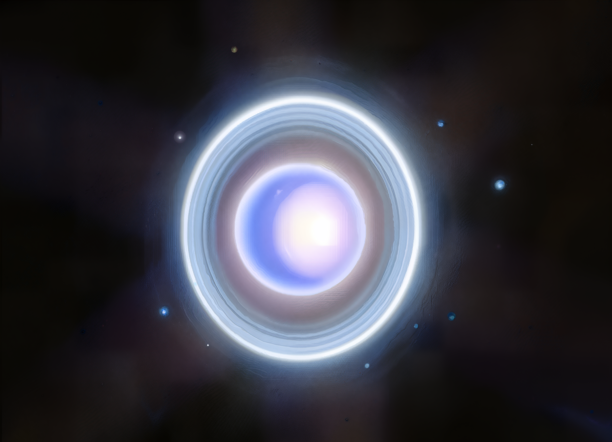
The planetary alignment on April 7, 2025, gave NASA a rare opportunity to study the atmosphere and rings of Uranus in remarkable detail. As the planet passed in front of a distant star located about 400 light-years from Earth, its atmosphere bent the starlight, creating what’s known as a “light curve.” This allowed scientists to measure the temperature, density, and pressure of Uranus’s stratosphere and track how these properties have changed over the past 30 years. The analysis was led by planetary scientist William Saunders from NASA’s Langley Research Center.
To observe this rare event, NASA coordinated with more than 30 astronomers across 18 observatories. The campaign involved both ground-based telescopes, such as the infrared telescope on Mauna Kea, and international partners who helped calibrate equipment and refine the orbit of Uranus—critical, given previous position estimates were off by up to 100 miles. These updated observations are expected to shed light on why Uranus’s upper atmosphere remains unusually hot.
Uranus is an ice giant located nearly 2 billion miles from Earth. Its atmosphere is made up of hydrogen, helium, and methane, layered over internal oceans of water and ammonia. It lacks a solid surface but is surrounded by 13 known rings and 27 moons. The only spacecraft to fly by Uranus was Voyager 2 in 1986, making detailed observations like these extremely rare.
NASA plans to continue its research on Uranus, particularly in preparation for the planet’s next major occultation event in 2031. The data collected in this campaign are already helping to refine models of Uranus’s motion, ring structure, and atmospheric dynamics, laying essential groundwork for future missions to the outer planets.
#space #science #educational #technology