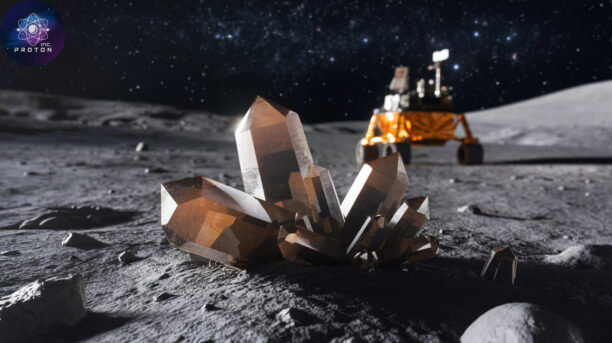
Chinese scientists have identified a unique mechanism of crystal growth in lunar soil samples brought back by the Chang’e-5 mission. Led by academician He Hongping of the Chinese Academy of Sciences, the research team observed unusual chromite nanocrystals forming mushroom-like structures on the surface of peridotite. The findings, published in American Mineralogist, provide significant insights into crystallization under space conditions.
To analyze the samples, researchers used a focused ion beam and high-resolution transmission electron microscopy, enabling a detailed examination of minerals at micro- and nanoscale levels. They discovered rare dendritic structures composed of chromite-troilite nanospherules and zero-valent iron. These nanospherules grow vertically from the surface of olivine, showcasing complex crystal formation mechanisms.
What makes these processes remarkable is their occurrence under extreme, non-equilibrium conditions, highlighting the unique mineral evolution on the Moon. The study not only sheds light on the nature of lunar materials but also opens new avenues for exploring crystallization processes in extraterrestrial environments.
#space #science #educational #technology