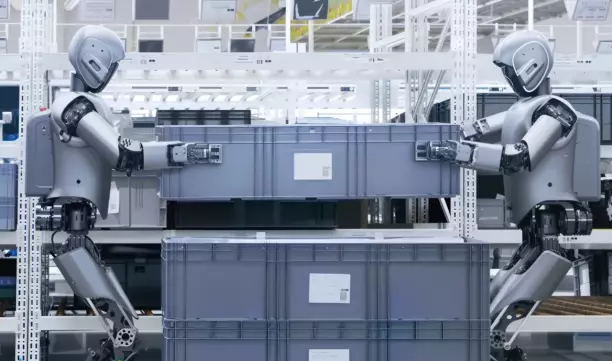
Chinese company UBTech has demonstrated significant progress in coordinating humanoid robots. In an experiment at the Zeekr factory, dozens of Walker S1 androids carried out manufacturing tasks, including sorting, transportation, assembly, and quality control. The robots used visual navigation and tactile sensors, allowing them to adapt to environmental changes, synchronously pass objects, and adjust movements when handling fragile materials.
The core of the control system is Swarm Intelligence technology, which coordinates robots through cloud and local data processing. “BrainNet” integrates intelligent nodes into a unified network, creating a “super-brain” for decision-making and a “sub-brain” for task execution. Hybrid algorithms enable efficient production planning, ensuring seamless robot collaboration.
A key element in robot adaptation is a multimodal model based on the Transformer architecture. It analyzes factory data and utilizes Retrieval-Augmented Generation (RAG) technology to quickly adjust robots to new tasks. UBTech states that the model was trained on industrial data collected from Walker S robots at automotive factories.
The company plans to release between 500 and 1,000 Walker S robots in 2025, aiming to accelerate automation in the automotive and electronics industries. The Zeekr factory was the first large-scale testing site, where engineers optimized control algorithms. Developers believe such systems will enable robots to operate not only in enclosed production environments but also in more dynamic settings.
#space #science #educational #technology