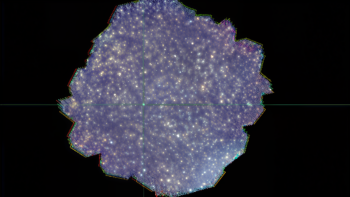

Astronomers from the Leibniz Institute for Astrophysics have discovered that the dwarf satellite galaxies of Andromeda are distributed in an extremely uneven pattern—over 80% of them are clustered on just one side of their host galaxy. This finding contradicts the standard cosmological model, which predicts a random distribution of satellites. Based on precise distance measurements to 37 satellites, nearly all of them lie within 107 degrees of the direction pointing toward the Milky Way.
Analysis of cosmological simulations showed that such a high degree of asymmetry occurs in only 0.3% of similar systems, making Andromeda a clear outlier. Moreover, about half of its satellites orbit in an organized, planar structure—further diverging from theoretical expectations. Current galaxy formation models fail to explain such a configuration.
Scientists studied over 300 simulated Andromeda analogs before finding even a single system with comparable asymmetry. This challenges our understanding of galaxy formation and the role of dark matter on small scales.
Future missions, such as the Euclid space telescope, and continued research into Andromeda’s merger history may help determine whether this is a unique anomaly or a sign that cosmological models need revision.
#space #science #educational #technology