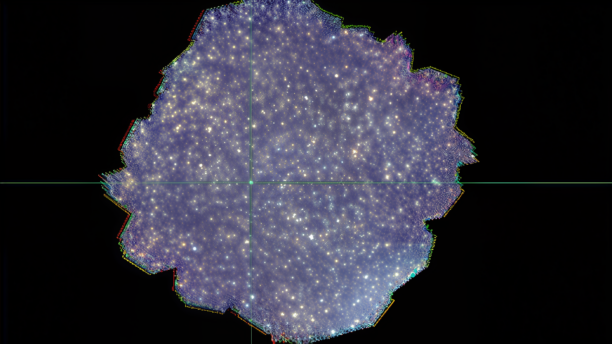
Astronomers using data from the Herschel Space Observatory may have uncovered a previously unknown population of faint dusty galaxies that had eluded earlier observations. If confirmed, these galaxies could significantly reshape our understanding of galaxy evolution and help explain the missing contribution to the universe’s infrared background radiation. Their faint glow may have gone unnoticed in standard observations, but their combined energy could account for the imbalance in the cosmic energy budget.
A team led by STFC RAL Space and Imperial College London has produced the deepest infrared map of the universe to date by combining 141 images from Herschel’s SPIRE instrument. This map, five times deeper than previous observations, reveals a dense concentration of dusty, star-forming galaxies. Due to their high density, the galaxies appear blended together in the image, making it difficult to distinguish individual sources.
To interpret this “noise,” the researchers used statistical analysis and detected signals from what could be an entirely new, extremely faint population of galaxies. These findings suggest a need to revisit current models of galaxy formation—particularly since half of all stellar energy is absorbed by dust and re-emitted in the infrared spectrum.
Confirming the existence of this hidden galactic population will require future missions, such as PRIMA—NASA’s proposed next-generation infrared telescope—which would bridge the observational gap between the James Webb Space Telescope and radio observatories. This discovery highlights the importance of infrared astronomy and shows that even concluded missions like Herschel can continue to deliver groundbreaking science.
#space #science #educational #technology