
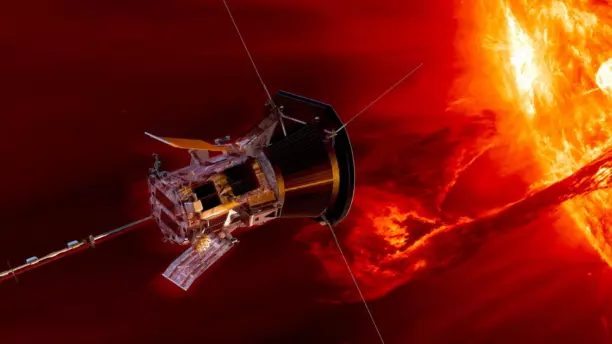
NASA’s Parker Solar Probe, launched in 2018, set another record on March 22, 2025, coming within just 6.1 million kilometers (3.8 million miles) of the Sun at a staggering speed of 192 km/s (119 miles per second). This marks the probe’s 23rd close flyby, allowing it to penetrate the Sun’s outer atmosphere and gather invaluable data on the corona and solar wind. Despite the extreme temperatures, Parker’s heat shield continues to reliably protect its scientific instruments.
Following the latest flyby, engineers at the Johns Hopkins Applied Physics Laboratory confirmed that the probe remains in good condition. It has three more similar approaches ahead—on June 19, September 15, and December 12, 2025. However, the mission is approaching its final phase: once its fuel supply is depleted, the spacecraft will lose its ability to adjust its trajectory, ultimately leading to its destruction under the Sun’s intense radiation.
Nevertheless, the probe’s most resilient components, including its heat shield, may persist in orbit around the Sun for billions of years. Parker has already revolutionized heliophysics, providing scientists with unprecedented insights into solar processes and their impact on Earth.
After the mission ends, humanity will simply observe as the probe slowly melts away, forever remaining in orbit around our star.
#space #science #educational #technology