
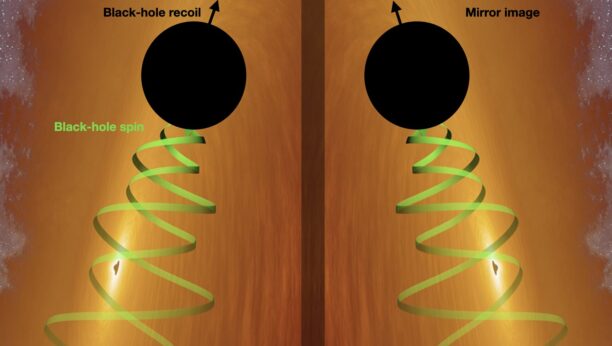
Spanish and Chinese physicists have investigated the mirror symmetry of the universe by analyzing black hole mergers. According to the cosmological principle, the universe should not favor rotation in one direction over another. Researchers examined the polarization of gravitational waves from 47 black hole pairs and found a symmetry violation in only one case—GW200129—despite theoretical predictions suggesting such anomalies should occur in 82% of cases.
Gravitational waves, predicted by Einstein, can exhibit right- or left-handed polarization, providing a way to test space-time symmetry. The observed lack of violations may be due to an insufficient volume of data. The orbital precession of GW200129 suggests a possible hierarchical formation of black holes, which has significant implications for astrophysics.
While the results are not yet conclusive, such studies are crucial for gathering more data on black hole mergers and testing fundamental physical theories. The question of whether quantum gravity violates any form of symmetry remains open, and future research may help provide an answer.
In the same context, a team of astronomers using the James Webb Space Telescope discovered an unusual supermassive black hole that barely absorbs any matter, challenging existing models of black hole evolution.
#space #science #educational #technology