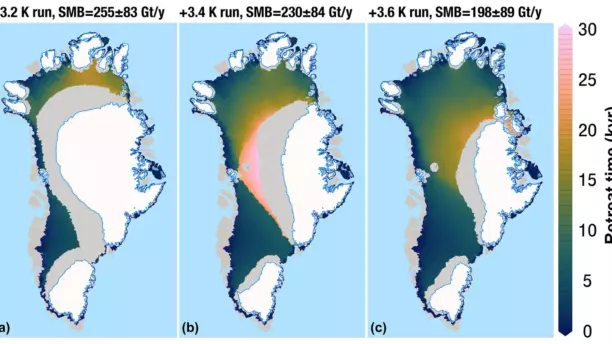
Scientists have determined a critical threshold for the melting of Greenland’s ice sheet, beyond which its collapse will become irreversible. According to a study published in The Cryosphere, this threshold is 230 billion tons of ice loss per year. If the rate surpasses this level, Greenland’s ice sheet could disappear within a relatively short time, causing a significant rise in global sea levels.
The Greenland Ice Sheet is the second-largest on the planet after Antarctica, covering over 1.8 million square kilometers with an ice thickness of up to 1.5 kilometers. The ice ranges in age from hundreds of thousands to millions of years. However, climate change is accelerating its melting, and if the process does not slow down, sea levels could rise by as much as seven meters, leading to catastrophic consequences for coastal regions.
Glaciologists estimate that if the critical melting rate is reached, Greenland could lose its ice sheet within a maximum of 40,000 years—or possibly much sooner. For now, the more elevated western part of the island is slowing the process, but if it is lost, further degradation will accelerate rapidly. Particularly concerning is the fact that since the mid-1980s, the rate of ice loss has increased sixfold.
Data show that from 1990 to 2000, Greenland lost an average of 41 billion tons of ice annually, but between 2010 and 2018, that number surged to 286 billion tons. If these calculations are correct, the ice sheet may have already crossed the “point of no return,” making its collapse inevitable.
#space #science #educational #technology