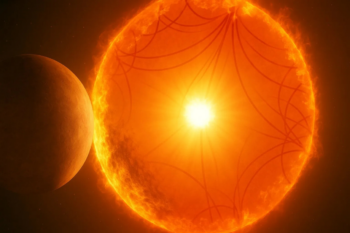

Using the Hubble Space Telescope, astronomers have observed a unique cosmic event — a wandering supermassive black hole consuming a star. The phenomenon, named AT2024tvd, occurred 600 million light-years from Earth and marks the first recorded case of a tidal disruption event (TDE) caused by a black hole located outside a galaxy’s center. The event was initially detected as a powerful flare by the Zwicky Transient Facility and confirmed by data from the Chandra X-ray Observatory and the Very Large Array radio telescope.
Typically, supermassive black holes reside in galactic cores. However, this black hole was found 2,600 light-years from the galaxy’s center — which itself hosts a larger black hole. According to Yuhan Yao of the University of California, Berkeley, this is the first such event observed in the optical spectrum and could point to the existence of a hidden population of “rogue” black holes.

Researchers believe this black hole may have been ejected from its original galactic center due to gravitational interactions or could be the remnant of a smaller galaxy that merged with the current one over a billion years ago. Remarkably, the host galaxy contains two unbound supermassive black holes — a rare configuration that intrigues scientists.
This discovery challenges existing models of galactic evolution and black hole distribution, showing that supermassive black holes can exist outside galactic centers and still interact dynamically with their surroundings.
#space #science #educational #technology