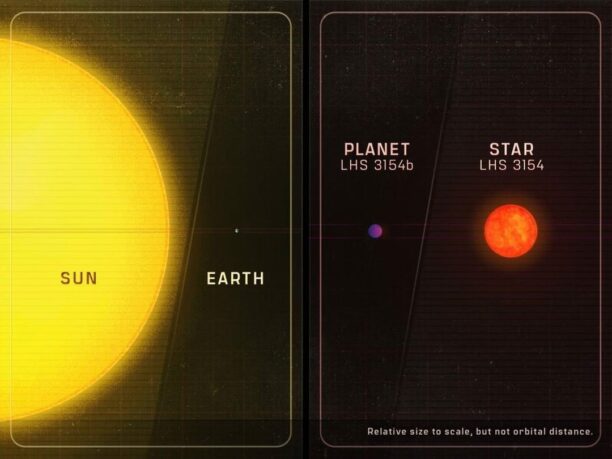
Astronomers have identified a groundbreaking exoplanet, LHS 3154b, that defies established theories of planetary formation. Published in Science, the study reveals that the planet is 13 times the mass of Earth, despite orbiting a cool dwarf star, LHS 3154, whose mass is just one-ninth that of the Sun. According to existing models, such a combination should be impossible.
Current planetary formation theory suggests that planets form from gas and dust disks surrounding a young star. The amount of material available for planet formation is believed to scale with the star’s mass—smaller stars should host smaller planets. Yet, for LHS 3154b to exist, its host star would need to be at least 10 times more massive.
This discovery challenges the long-held assumption that low-mass stars cannot produce planets of such significant size. Researchers speculate that either the formation models need revision or unique, previously unknown processes occurred in this system, enabling the creation of such a massive planet.
LHS 3154b now stands as a prime target for further investigation. Detailed studies of its atmosphere and composition could offer vital clues about how planets form in extreme conditions. Additionally, this finding broadens the horizons of exoplanet research, suggesting that massive planets may be more common around small stars than previously thought.
#space #science #educational #technology