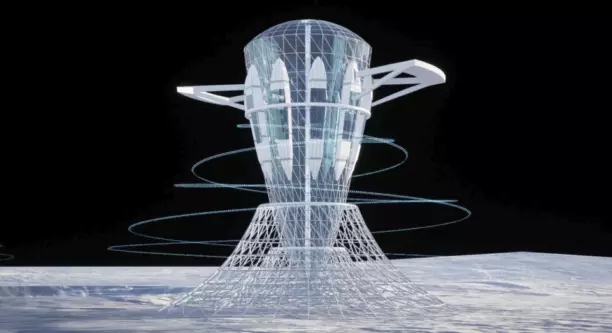
Japanese scientists have proposed a solution to the problem of weak gravity on the Moon, which can lead to muscle atrophy, circulation issues, and other serious health problems for astronauts. They have developed a concept for Neo Lunar Glass, a massive inverted cone-shaped structure capable of generating artificial gravity. The plan is to build this 400-meter-high structure, roughly the size of the Ostankino Tower, on the Moon by the 2030s.
Neo Lunar Glass will be mounted on a foundation and powered by special engines to ensure continuous rotation. The centrifugal force generated by this rotation will create artificial gravity, allowing residents of the complex to move along the interior walls of the cone, which will function as floors.
The idea of generating artificial gravity through rotation has been actively explored since the early days of space exploration. Similar concepts are being developed for building space stations in cylindrical or toroidal shapes. An example of practical implementation is the centrifuge used at the Russian Institute of Medical and Biological Problems, where various levels of artificial gravity are created for astronaut training.
The goal of the Neo Lunar Glass project is to minimize the negative effects of weak gravity on the human body. In low gravity, muscles, bones, vision, and fluid circulation can suffer. Creating artificial conditions like these on the Moon will provide a more comfortable and safe living environment for future inhabitants of the lunar surface.
#space #science #educational #technology